Tanks Designed for Chemicals
When storing chemicals, choosing a strong or large tank is not enough. The substance, its concentration, and its temperature affect the choice of material, design, and fittings. Tanks designed for chemicals therefore help you store substances more safely when selected for the intended application.
In this article, we explore chemical tank materials and designs, the difference between vertical and horizontal tanks, substances suitable for storage, key quality, safety, and maintenance criteria, and factors affecting price. We also review Poly Tank solutions and products suitable for certain chemical applications to help you choose the right tank for your project.
What Are Tanks Designed for Chemicals?
Tanks designed for chemicals are tanks used to store chemical substances, with their materials and fittings selected to suit the stored substance.
Chemical storage tanks are used in many industrial applications that require the storage of chemicals or chemical solutions, including certain manufacturing, treatment, and industrial storage processes. Tank design and fittings vary according to the substance and how it is handled.
It is important to distinguish a tank designed for a specific chemical from a general-purpose tank. A tank being made of polyethylene does not automatically make it suitable for every chemical. Compatibility with the substance, its concentration, and its temperature must be confirmed before use.
What Are Tanks Designed for Chemicals Made From?
Materials used to manufacture a tank for chemical substances vary according to the substance to be stored, its concentration, its temperature, and operating conditions. Materials used in this field include polyethylene and fiberglass-reinforced plastic (FRP), as well as steel and stainless steel for certain industrial applications.
Polyethylene is a practical choice for certain chemical storage applications because of its resistance to corrosion and rust, light weight, and ease of handling compared with many metallic materials. Different types of polyethylene are used to manufacture tanks, so compatibility with the specific chemical must be confirmed before the tank is approved.
Poly Tank offers polyethylene products suitable for certain industrial and chemical applications, including polyethylene tubs that resist chemicals, acids, and alkalis. They are available in different sizes and designs to meet project needs.
Choosing tanks designed for chemicals therefore depends on more than the material alone. The substance, its concentration, its temperature, and storage method must be reviewed, followed by selection of the appropriate design and fittings to ensure safe use and the required efficiency.
Tanks Designed for Chemicals at Different Concentrations
Tanks designed for chemicals can be used with different concentrations, but material compatibility must be reviewed for each substance, concentration, and temperature before operation.
A material may be suitable for a chemical at a particular concentration, while its suitability changes as concentration or temperature increases. The substance's technical data must therefore be established before the tank is manufactured or approved.
Key information to establish includes:
- The chemical's name and composition.
- The required concentration.
- Storage and operating temperature.
- The substance's specific gravity.
- The expected storage period.
- The filling and discharge method.
- Conditions at the tank installation site.
Contact Poly Tank and share the substance, its concentration, and storage conditions. Our team will help you choose the chemical storage tank, material, and fittings best suited to your needs.
Poly Tank: The Best Provider of Tanks Designed for Chemicals
Poly Tank provides polyethylene solutions for certain chemical storage applications, with local manufacturing and experience supplying products to projects.
Poly Tank has specialized experience in manufacturing polyethylene products. Its journey in this field began in 2011, supplying products to multiple sectors, including chemical industries, water treatment and desalination, agriculture, construction, and contracting.
The company manufactures directly in Egypt, providing greater flexibility in determining capacity, design, and fittings according to project needs, with the opportunity to discuss the chemical and storage conditions before approving the product.
Poly Tank was also among the first companies in Egypt to introduce brass bushings in polyethylene tank inlet and outlet openings in 2013, making installation easier and reducing the need to drill unplanned openings in the tank body. The company's experience supplying projects supports our ability to meet the needs of different sectors. We also have agents and distributors for our products across Upper Egypt and partnerships with companies and projects in various sectors.
When ordering tanks designed for chemicals, you can therefore contact us at Poly Tank to share the substance, its concentration, its temperature, and storage conditions, and review product suitability and required specifications before supply.
Advantages of Poly Tank's Tanks Designed for Chemicals
Advantages of Poly Tank's tanks designed for chemicals include resistance to corrosion and chemicals, light weight, easy cleaning, and a variety of solutions and designs.
Poly Tank offers a range of polyethylene products for different industrial applications, with each product having different properties and methods of use.
Polyethylene Tubs for Chemical Applications
Among solutions for tanks designed for chemicals, polyethylene tubs provide a practical option for storing and processing materials and liquids in industrial and agricultural applications.
Polyethylene tubs offer excellent resistance to chemicals, acids, and alkalis, as well as moisture and corrosion resistance. Their smooth internal surfaces make cleaning easier and reduce sediment buildup. They are available in different capacities to suit project needs.
Polyethylene Baskets for Industrial Applications
Polyethylene baskets are among the solutions for tanks designed for chemicals associated with storing, transporting, and handling products and materials within workplaces.
The baskets feature a strong design that withstands repeated transport and storage, along with light weight, moisture and corrosion resistance, and easy cleaning. They are also used in certain chemical-related industrial applications, including storage and transport processes in the spinning and textile sector.
Vertical Polyethylene Tanks
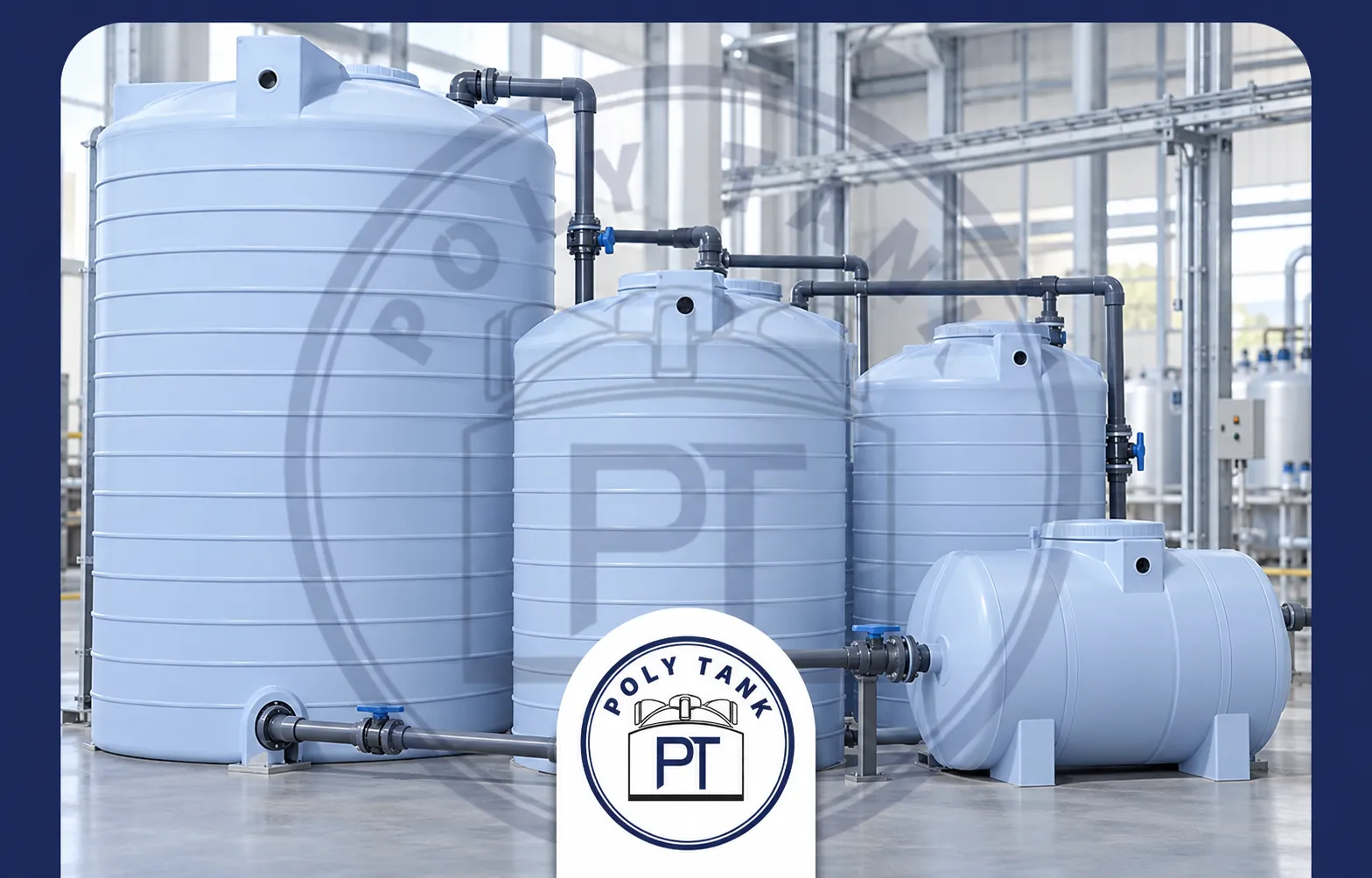
Vertical polyethylene tanks designed for chemicals are lightweight and resistant to corrosion and chemicals, with a vertical design that helps make use of the available space.
Vertical tanks are made from 100% virgin LDPE, free of recycled materials, and feature a smooth, nonporous internal surface that is easy to clean. They also resist chemicals at different concentrations. However, the company or agent must be consulted before storing any substance other than water to confirm the tank's suitability for the substance and its conditions of use.
Horizontal Polyethylene Tanks
Horizontal tanks designed for chemicals provide a practical solution for sites that require a horizontal design, with chemical resistance, light weight, and easy cleaning.
Horizontal tanks are made from 100% virgin LDPE and produced by rotational molding without welded joints. They feature a three-layer design, a smooth internal surface, and brass bushings to facilitate installation. They also resist weathering, impact, corrosion, and chemicals at different concentrations. The company must be consulted before they are used to store any substance other than water.
Each product's advantages therefore vary according to its application. Tubs suit certain storage and processing applications, baskets support industrial storage and transport, and vertical and horizontal tanks offer different shapes and capacities. The chemical, its concentration, and its temperature must always be specified before the appropriate tank is approved.
The Chemical Storage Tank: The Best Approach to Storing Chemicals
Tanks designed for chemicals help store substances safely when the material, design, and fittings are compatible with the substance and operating conditions.
To ensure a chemical tank operates efficiently and lasts longer, several practices should be followed during installation and use, including:
- Provide appropriate ventilation: The tank must be fitted with an appropriate vent.
- Protect the tank base: Install the tank on a suitable, level base, with an appropriate barrier or protective layer between the tank body and the surface to reduce friction or wear caused by contact with concrete.
- Protect against sunlight: When installing the tank in an exposed location, consider the material's resistance to ultraviolet radiation. A suitable cover or protection method can be provided according to the tank and installation location.
- Clean and inspect regularly: Regular cleaning and removal of sediment and buildup help protect the tank body and connections, along with checking for signs of damage or leakage.
- Use flexible connections when needed: Flexible connections accommodate expansion and contraction caused by temperature changes and reduce stress on connection points.
- Minimize side openings: Fewer unnecessary openings in the tank body mean fewer connection points that could leak. Opening locations and fittings should therefore be specified according to the application.
- Avoid mixing substances: Different chemicals must not be stored together in the tank without confirming their compatibility. Reusing a tank for another substance is also not recommended until material compatibility has been confirmed and the tank has been cleaned and prepared appropriately.
Successful chemical storage therefore depends on more than choosing the tank. It also includes installing, fitting, operating, and maintaining it in a way that suits the stored substance.
Chemicals That May Be Stored in a Chemical Storage Tank
Certain chemicals can be stored in polyethylene tanks when the substance, its concentration, and its temperature are compatible with the material.
Examples of substances that may be compatible with polyethylene tanks include:
- Hydrochloric acid: Concentrations of 20% and 37% can be stored.
- Hydrogen peroxide: It can be used at specific concentrations, such as 10%.
- Citric acid and calcium chloride: They can be stored in polyethylene tanks under suitable conditions of use.
- Sodium hydroxide: Concentrations up to 20% can be stored.
- Potassium hydroxide: It can be stored at concentrations up to 50%.
- Sodium hypochlorite: It can be stored at concentrations up to 20%, subject to storage conditions and compatibility.
- Phosphoric acid: It can be used at concentrations up to 40%.
- Sulfuric acid: It can be used at concentrations up to 10% under specified storage conditions.
- Ethylene glycol and certain chemical solutions and salts may also be suitable, subject to chemical compatibility.
For Poly Tank's tanks designed for chemicals, the company provides polyethylene solutions for certain industrial and chemical applications. The substance's name, concentration, and temperature must be reviewed before the tank is approved to ensure that the material and fittings are compatible with the intended use.
Manufacturing Quality of Tanks for Chemical Substances
The manufacturing quality of tanks for chemical substances depends on material uniformity, molding precision, and the quality of connections and fittings, reducing the likelihood of leakage and damage.
Manufacturing quality is reflected in several key elements:
- Uniform tank body: Consistent manufacturing helps distribute the material appropriately.
- Appropriate thickness: Thickness must be specified according to capacity, the substance, and operating conditions.
- Quality of connection points: Openings and connections must suit the substance and operating method.
- Manufacturing precision: Precision reduces problems caused by an uneven tank body or incorrectly installed fittings.
- Internal surface quality: A smooth surface makes cleaning and inspection easier.
- Appropriate design selection: The design must suit capacity, installation method, and loading.
At Poly Tank, we use rotational molding to manufacture polyethylene tanks. This technique helps produce a uniform tank body without welded joints.
The Importance of Manufacturing a Chemical Storage Tank with High Precision
Precision in manufacturing a chemical tank helps improve storage safety, reduce leakage risks, and better align the tank with operating requirements.
Manufacturing tanks designed for chemicals involves more than selecting a material resistant to the stored substance. It also includes designing the tank to suit the application, storage volume, and filling and discharge method. Connection points and material flow paths must also be considered to ensure efficient and safe tank operation.
The importance of manufacturing precision is evident in several areas, including:
- Reduce the likelihood of leaks and spills: Skilled manufacturing and correctly prepared connection points help reduce weak points that could cause substances to leak.
- Improve operating efficiency: When a tank is designed for the process, it can be connected to piping, filling, and discharge systems in a way that better suits the required flow rate.
- Withstand operating conditions: Tank design must suit the weight of the stored substance and external conditions affecting it, such as heat, wind, and installation method.
- Improve storage efficiency: Fixed tanks allow larger quantities of liquids to be stored, reducing the need for repeated transport and handling and potentially helping lower supply costs or the cost of disposing of wasted liquids.
- Facilitate inspection and maintenance: Precise design and early specification of opening locations, connections, and fittings make inspection, cleaning, and maintenance easier when needed.
- Reduce operating risks: The more compatible the tank, its design, and its fittings are with the substance and its conditions of use, the more organized and safer its handling becomes.
The quality of a tank for chemical substances therefore begins with studying the stored substance and operating conditions, then selecting the appropriate material, design, capacity, and fittings, rather than considering shape or size alone.
Designing a Leak-Resistant Chemical Tank
Designing leak-resistant tanks designed for chemicals relies on a uniform body, suitable connections, correct installation, and inspection before use.
Certain polyethylene manufacturing features, such as producing the body as a uniform unit without welds, help reduce weak points in the tank body. However, leak resistance depends on more than the body alone. It also includes openings, connections, valves, and the installation method.
The following should therefore be considered:
- Choose a material compatible with the chemical.
- Specify opening and connection locations before manufacturing.
- Use connections and components suitable for the substance.
- Place the tank on a suitable, level base.
- Inspect connection points after installation.
- Conduct an appropriate test to confirm the tank's integrity before putting it into service.
Safety Requirements When Using a Tank for Chemical Substances
Safety requirements when using a tank for chemical substances include inspection before operation, clear identification of the substance, emergency preparations, and employee training.
Inspect the Tank Before Operation
Before use, inspect the chemical storage tank body for cracks, scratches, or leaks, and review seals, gaskets, connection points, and tank level indicators. If the system has special pressure or mixing equipment, ensure it is sound and operates according to the operating instructions.
Substance Identification and Safety Data
The stored substance must be known and clearly identified, with its safety data available in an easily accessible location. OSHA guidance emphasizes making chemical labels and safety data sheets available to employees, along with training them on hazards and safe handling methods.
Employee Training
Employees must understand the substances present in the workplace, their associated risks, and how to handle leaks or emergencies. They must also receive training on operating procedures and protective equipment appropriate to the work.
Emergency Preparedness
Clear procedures must be established for handling leaks, accidents, and fires, identifying employee responsibilities, evacuation routes, and ways to request assistance, with emergency equipment suitable for the stored substance. Regular drills also help ensure employees can carry out the procedures when needed.
Safe use of tanks for chemical substances therefore depends on combining tank integrity, clear substance information, employee training, and advance preparation for emergencies.
Factors Affecting the Price of Tanks Designed for Chemicals
Prices for tanks designed for chemicals start at EGP 2,000 for tubs and EGP 4,000 for baskets. Costs vary according to capacity and specifications.
The final price varies according to the product and application requirements. Key factors affecting the cost of tanks designed for chemicals include:
- Capacity.
- Material type
- Product thickness
- Required quantity.
- Transportation.
In addition to:
- Design: Price varies according to product design, whether vertical, horizontal, or tub-shaped, as well as dimensions and installation method.
- Openings and connections: The number and size of openings and the type of required connections affect cost, especially when customized filling or discharge fittings are needed.
- Additional fittings: Such as valves, level indicators, and filling and discharge equipment, according to application needs.
Prices of Selected Available Polyethylene Products
Poly Tank offers polyethylene products that can be used in certain applications for storing and handling chemicals. Their prices vary by product and capacity:
- Polyethylene tubs: Available capacities range from 250 to 2,500 liters, with prices ranging from EGP 2,000 to EGP 16,000.
- Polyethylene baskets: Available capacities range from 750 to 1,000 liters, with prices ranging from EGP 4,000 to EGP 5,000.
When ordering a chemical tank customized for a specific substance, the price is determined according to the required specifications, the chemical, its concentration, its temperature, and the necessary fittings.
For an accurate price suited to your needs, contact Poly Tank and share the chemical's name, concentration, required capacity, and design. We will help you identify the appropriate product and specifications before supply.
Storing Chemicals in a Vertical or Horizontal Chemical Tank
Vertical or horizontal tanks designed for chemicals are selected according to site space, storage volume, installation method, and the requirements of the stored substance.
|
Comparison |
Vertical Tank |
Horizontal Tank |
|
Space utilization |
Uses height and requires relatively less floor space. |
Requires more floor space but suits sites with limited height. |
|
Height |
Requires sufficient installation height and safe access when needed. |
Suitable for sites that cannot accommodate a tall tank. |
|
Base and support |
Requires a level base suited to the tank's size and weight. |
Requires a base or support points designed for its shape and size. |
|
Ease of access |
Large capacities may require suitable access equipment for openings. |
Some tank points may be easier to access depending on design and installation height. |
|
Capacities |
Suitable for storing large quantities while reducing floor space. |
Suits certain capacities and applications requiring a greater horizontal span. |
|
Selection by site |
Suitable for sites with sufficient height. |
Suitable where vertical space is limited. |
Neither design can be considered universally better. Choosing a tank for chemical substances also depends on the substance, its concentration, its temperature, the storage method, and site requirements.
Chemical Storage Tanks: 100% Egyptian Manufacturing
Poly Tank's tanks for chemical substances are manufactured in Egypt, with products supplied to projects and customers through the distribution network in the Egyptian market.
Working with a local manufacturer offers practical advantages, including:
- Manufacturing in Egypt: Obtain tanks designed for chemicals from a local manufacturer.
- Distribution within the Egyptian market: A network of agents and distributors makes products available in different regions.
- Easy communication and follow-up: Discuss project needs and required specifications directly.
- Flexible supply: Meet the needs of individuals, projects, and different order quantities.
Poly Tank thus combines local manufacturing with distribution in Egypt, making products easier to access and project requirements easier to follow up.
Differences Between Chemical Storage Tank Types: Which Is Best?
No single type of tank designed for chemicals suits every substance. The best choice depends on material compatibility with the chemical, its concentration, its temperature, and storage conditions.
|
Tank Type |
Key Advantages |
Suitable Applications |
|
Fiberglass (FRP) tanks |
Lightweight, strong, and corrosion-resistant |
Harsh chemicals and corrosive environments |
|
Nickel alloy tanks |
High strength and good corrosion resistance |
A wide range of chemicals and industrial applications |
|
Stainless steel tanks |
Resist rust and corrosion and withstand temperature and pressure |
Certain acids, bases, solvents, and applications requiring high durability |
|
Polyethylene tanks |
Lightweight, strong, and resistant to corrosion and many chemicals |
Certain acids, bases, and solvents, after confirming material compatibility |
|
Polypropylene (PP) tanks |
Resist many chemicals and suit high temperatures |
Certain applications requiring greater heat resistance |
|
Carbon steel tanks |
Strong and less expensive than stainless steel |
Certain noncorrosive applications and transport of substances such as fuel and oils, subject to design |
Which Type Is Best?
Choosing a chemical storage tank depends on the stored substance and operating requirements, rather than material strength or price alone. Polyethylene is a practical choice in many chemical applications once compatibility with the substance, its concentration, and its temperature is confirmed.
Designs for tanks designed for chemicals also vary according to site space. Vertical designs suit locations where height can be used, while horizontal designs suit sites with limited height.
Key Tips for Choosing a Tank for Chemical Substances
Choosing a tank for chemical substances depends on the substance's properties, operating conditions, capacity, and required fittings, rather than tank shape alone.
Before purchasing, review these points:
- Substance properties: Specify the substance, its concentration, and pH, and whether it is oxidizing, acts as a solvent, or may affect the material.
- Temperature: Review the substance's storage temperature and potential changes.
- Site conditions: Determine whether the tank will be indoors or outdoors and its exposure to sunlight, ultraviolet radiation, and moisture.
- Operating conditions: Confirm pressure or vacuum requirements and the filling and discharge process.
- Capacity and fittings: Specify the storage volume and any special fittings, such as inspection openings, inlets, outlets, and level indicators.
- Substance data and standards: Share the safety data sheet (SDS/MSDS) and project requirements with the manufacturer to confirm that the material and design suit the application.
This allows you to select suitable chemical storage tanks based on actual operating needs and the specifications of the stored substance.
Why Choose Poly Tank When Buying Tanks Designed for Chemicals?
Choosing tanks designed for chemicals from Poly Tank draws on its experience manufacturing polyethylene products and providing solutions suited to industrial applications.
Key reasons to choose Poly Tank include:
- Experience in polyethylene manufacturing: The company has experience manufacturing polyethylene products for different applications.
- Direct manufacturing: Working with the manufacturer provides greater clarity on product specifications and required fittings.
- Product variety: Solutions include polyethylene tubs, baskets, and tanks for different applications.
- Experience across industrial sectors: This includes working with chemical, water treatment and desalination, agriculture, construction, and contracting sectors.
- Technical support before purchase: The team helps review the intended use and chemical data before approving the product.
- Flexibility for project needs: Capacity, design, and fittings can be discussed according to each project's requirements.
Ultimately, choosing tanks designed for chemicals is an essential part of successful storage. The better the material, design, and fittings match the application, the more efficient and stable the solution will be over the long term.
With Poly Tank, you can rely on the experience of a manufacturer specializing in polyethylene products to meet different industrial application needs.
Start choosing the right solution for your project today. Contact Poly Tank for the product and specifications that match your needs.